Kevin Jacob — Postdoctoral Research Scholar, Iowa State University
Materials for extreme environments protect people, structures, and the planet — from radiation inside a reactor core, to the heat inside a turbine blade, to the cold vacuum of orbit. Understanding how materials survive these extremes is the first step toward engineering ones that can.
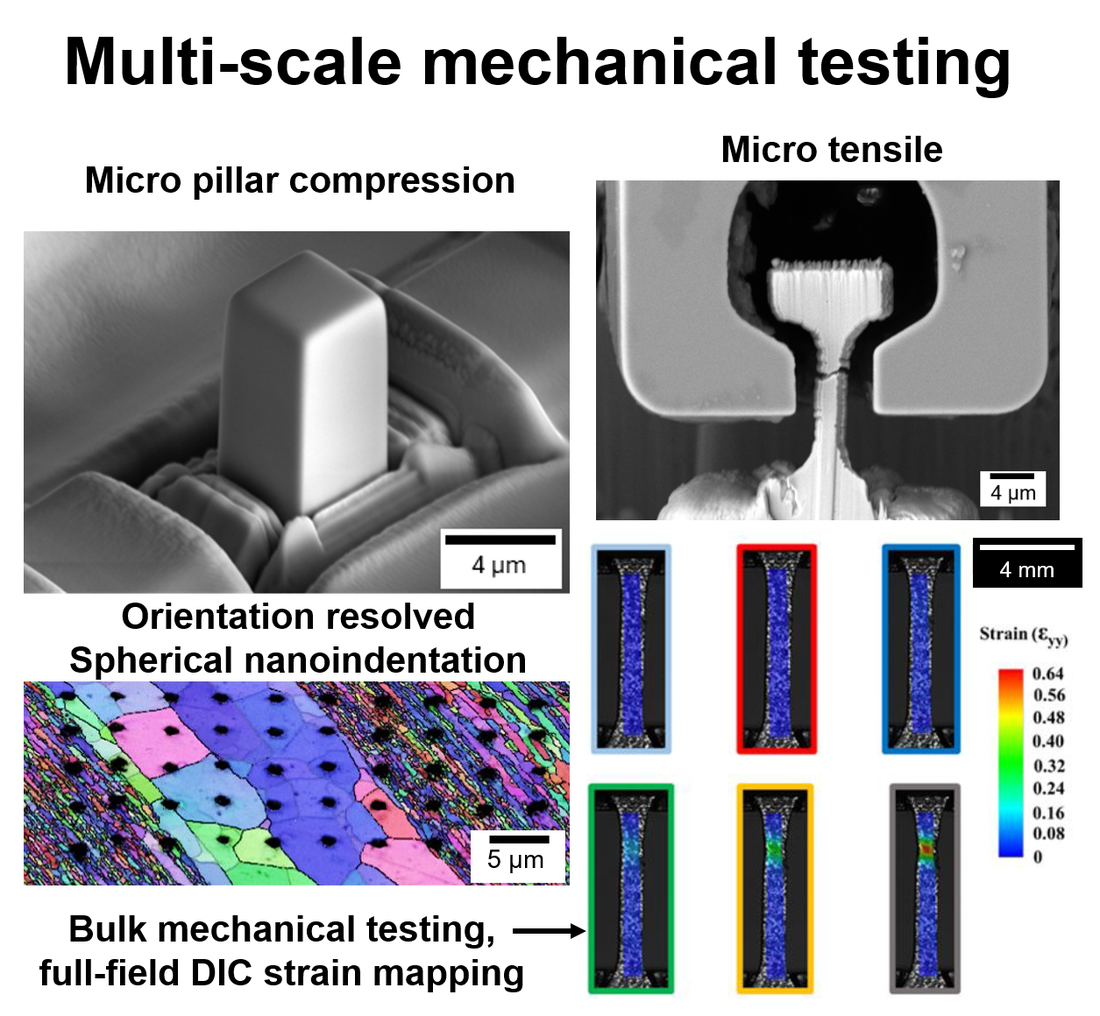
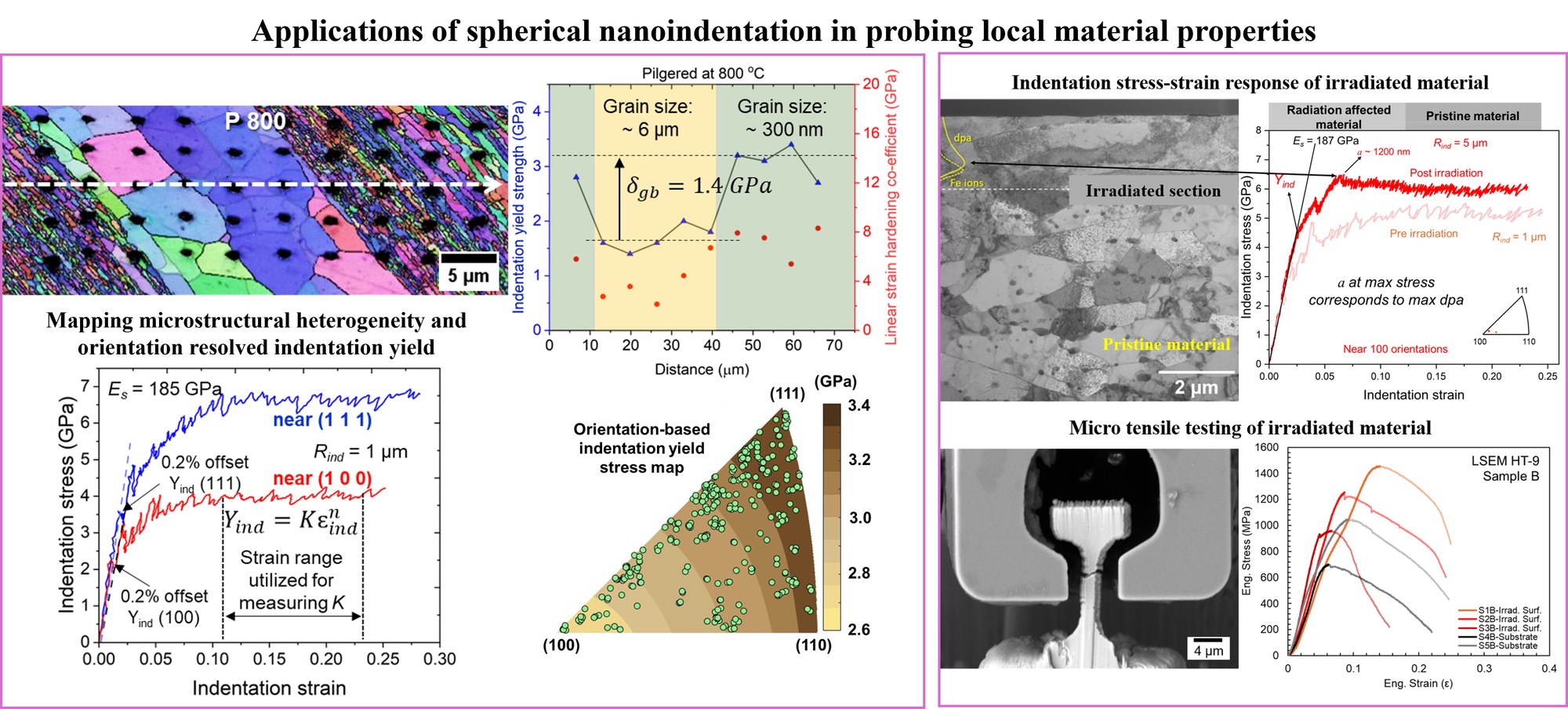
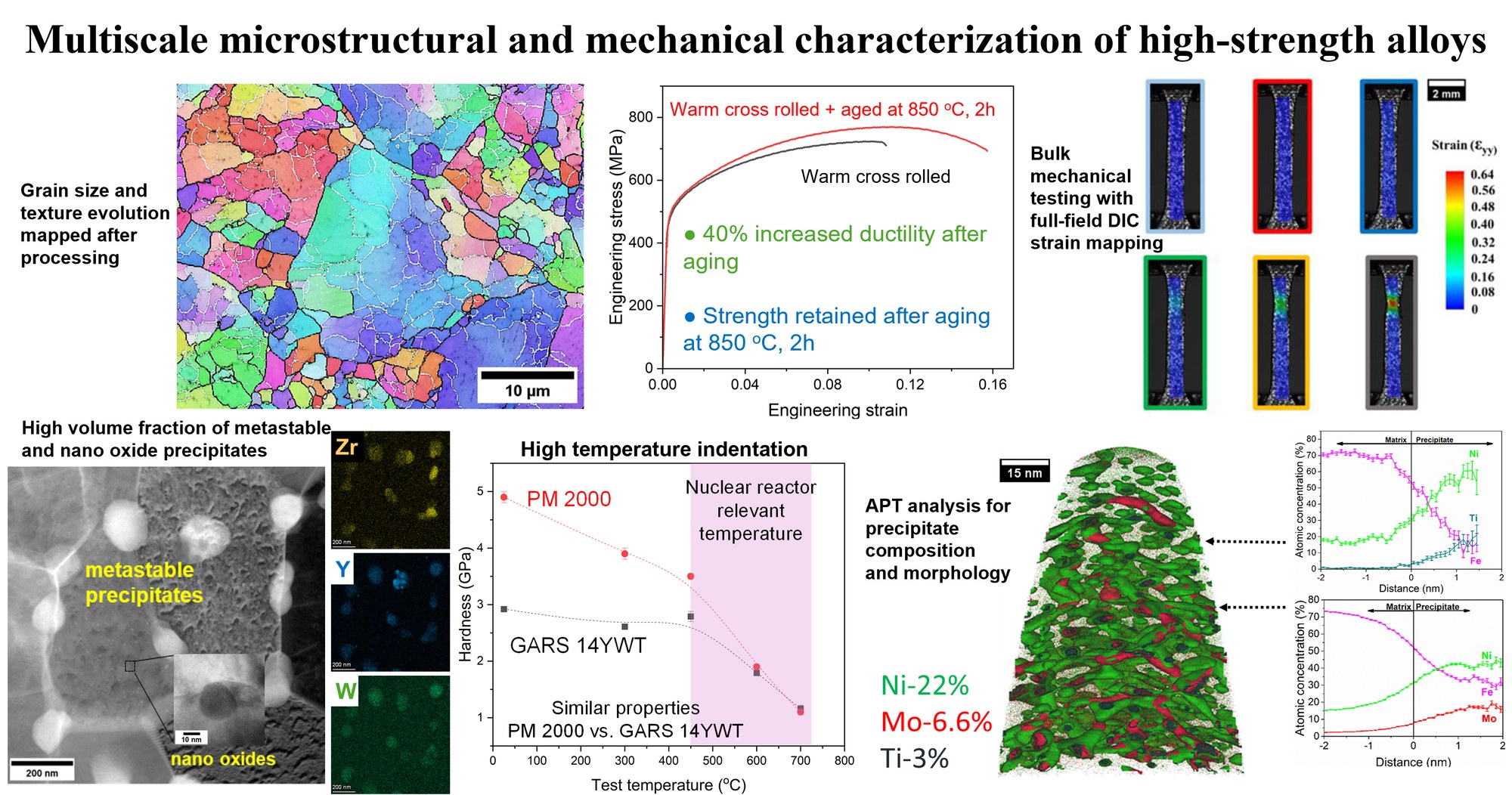
From µm to mm, I bridge the micro, meso, and macro length scales to understand how a material’s microscopic structure dictates its overall performance. High-throughput nanoindentation makes it possible to map mechanical behaviour rapidly across many orientations and phases, and to test materials available only in tiny volumes — from neutron-irradiated samples too hazardous to handle in bulk, to rare fossilised and meteoritic specimens.
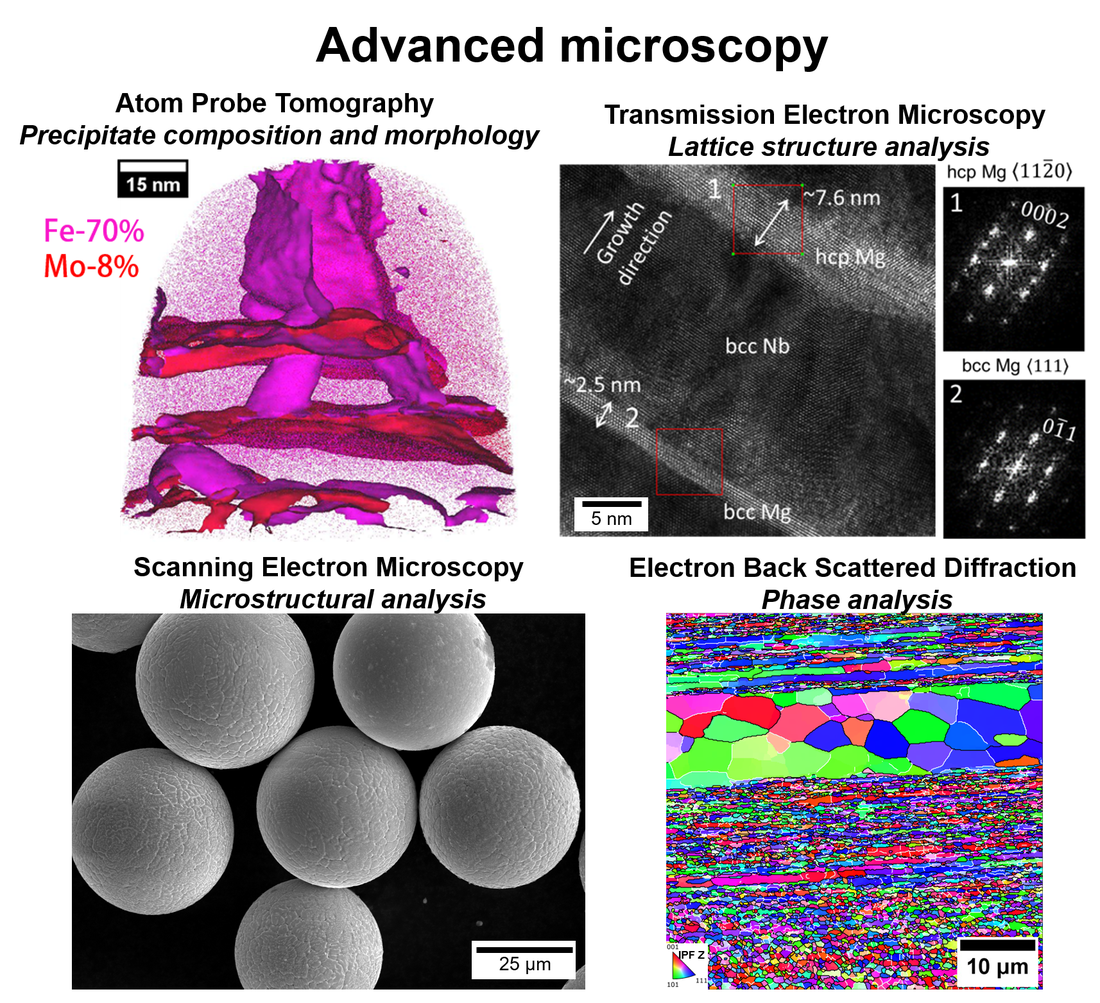
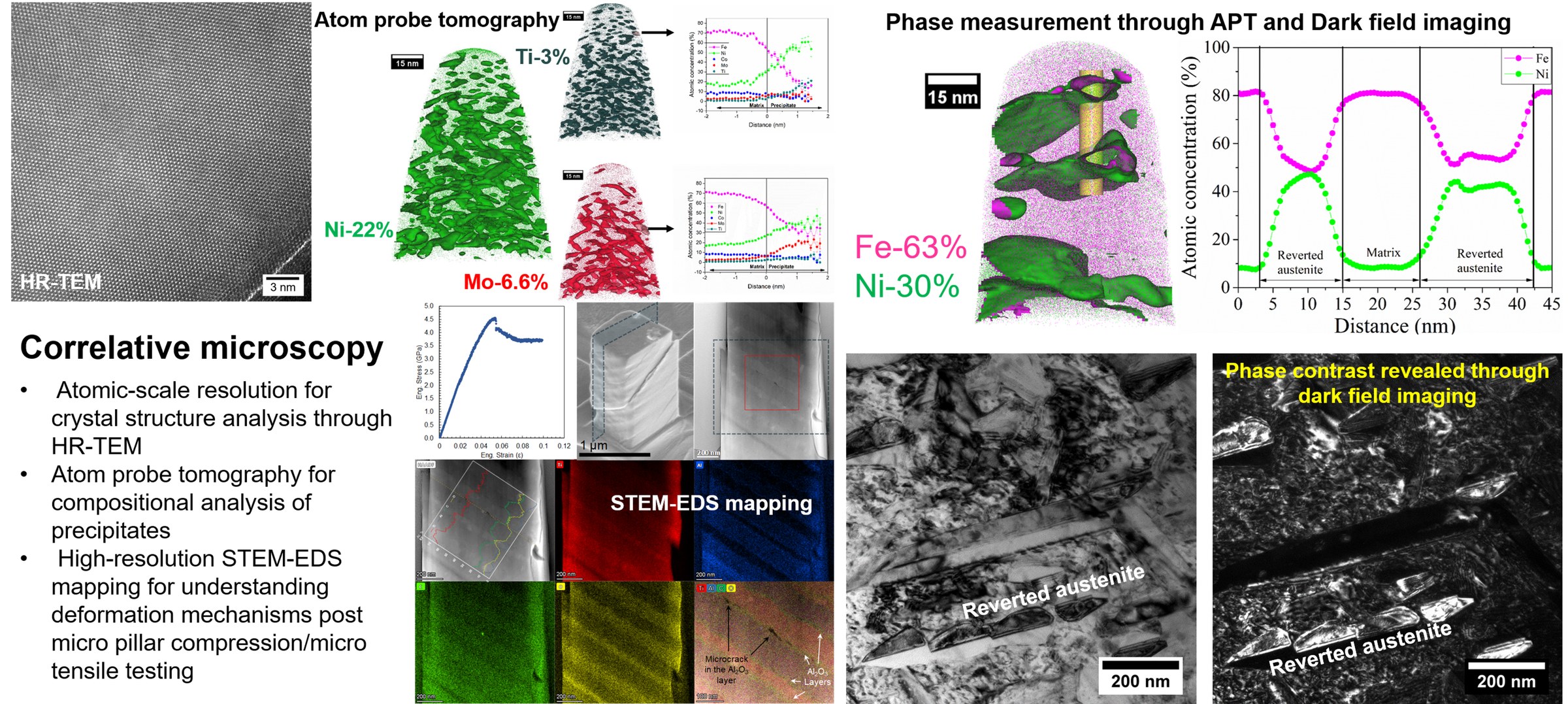
From single atoms to bulk grain structure, I use correlative microscopy to resolve a material’s structure across scales — atom probe tomography for precipitate composition and morphology, transmission electron microscopy for lattice and interface analysis, and SEM and EBSD for microstructure and phase distribution. Combining them on the same material links chemistry and structure directly to mechanical behaviour.
Click to enlarge ↗
Click to enlarge ↗
Click to enlarge ↗
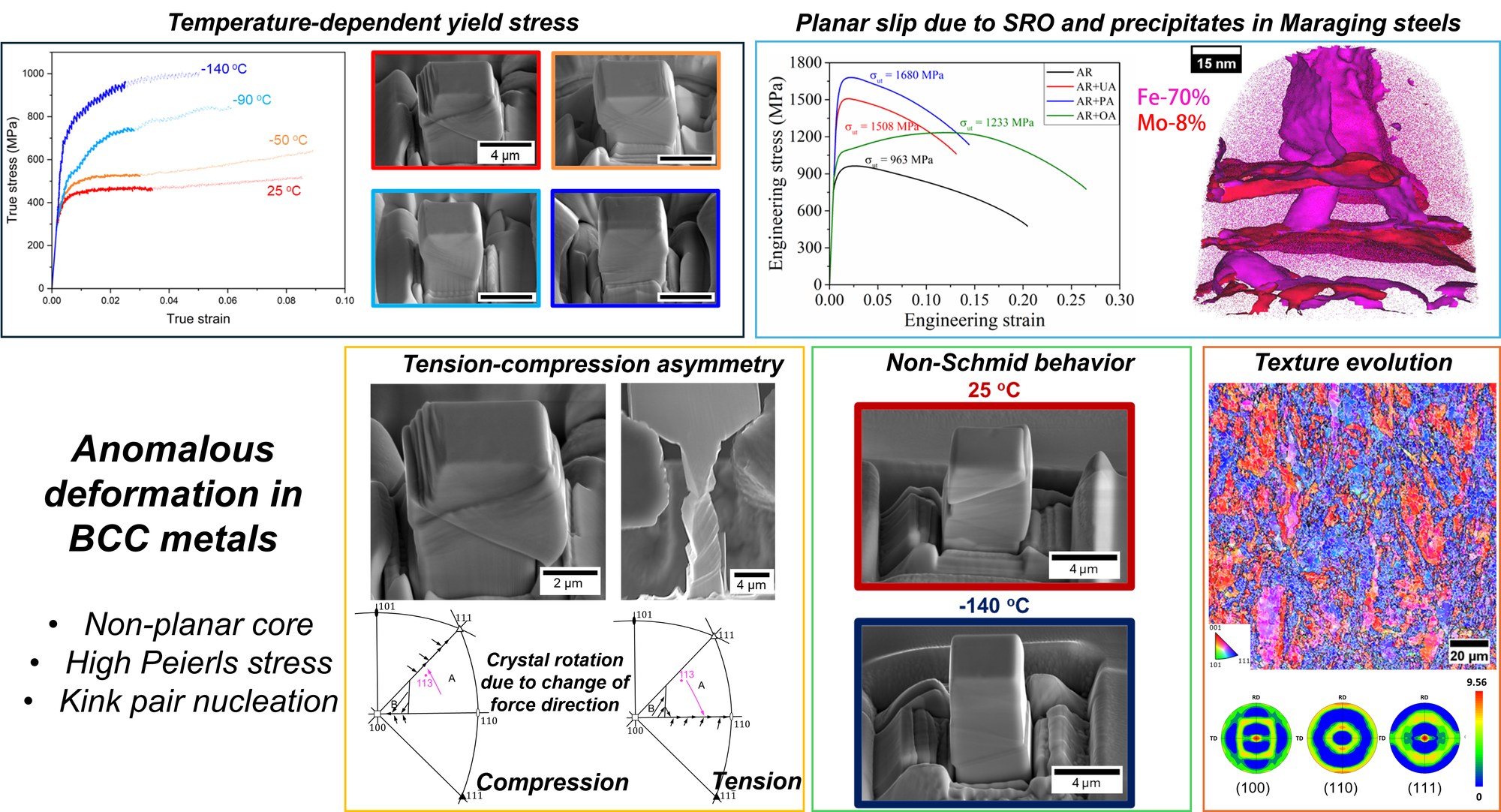
In-situ SEM micropillar compression of the same material in two crystallographic orientations. The orientation of the loading axis relative to the available slip systems changes how the pillar deforms — from the slip offsets and shear character to the overall shape change.
In-situ SEM micro-tensile testing. The ⟨114⟩-oriented tantalum deforms by homogeneous, distributed slip, the ⟨113⟩ orientation by multiple single slip, while the irradiated HT-9 undergoes crack nucleation and failure driven by irradiation-induced damage.
I am currently a Postdoctoral Research Scholar at Iowa State University. I completed my Ph.D. at IIT Bombay, where I worked on the precipitation and deformation behaviour of maraging steels subjected to different levels of strain.
My research centers on quantitative, multiscale mechanical characterization of BCC metals and extreme-environment alloys — integrating multiscale mechanical testing with advanced microscopy to connect deformation mechanisms across length scales, from individual dislocations to bulk mechanical response.
Two things drive my work: the discovery involved in solving problems of real consequence to the world, and the opportunity to mentor the next generation of researchers and pass that knowledge forward.
Materials Science & Engineering. Advisor: Dr. Sid Pathak. Deformation mechanisms and phase transformations in advanced structural materials using nanomechanical testing and advanced microscopy.
Advisor: Dr. Nagamani Jaya Balila. Effect of deformation processing on the mechanical and precipitation behaviour of maraging steels.
Fatigue crack initiation from holes. GPA 9.2/10; Silver Medalist, Department Topper 2017.
CFD analysis of flame in a burner.
A selection of first-author and key contributions. Author names in bold indicate first-author work. My full publication list (13 papers) and conference presentations are in my CV.